
Riding tips
How to travel by bus in Delhi: a first-timer’s guide
Updated · 8 min read · Figures from Delhi’s Open Transit Data, imported 18 July 2026
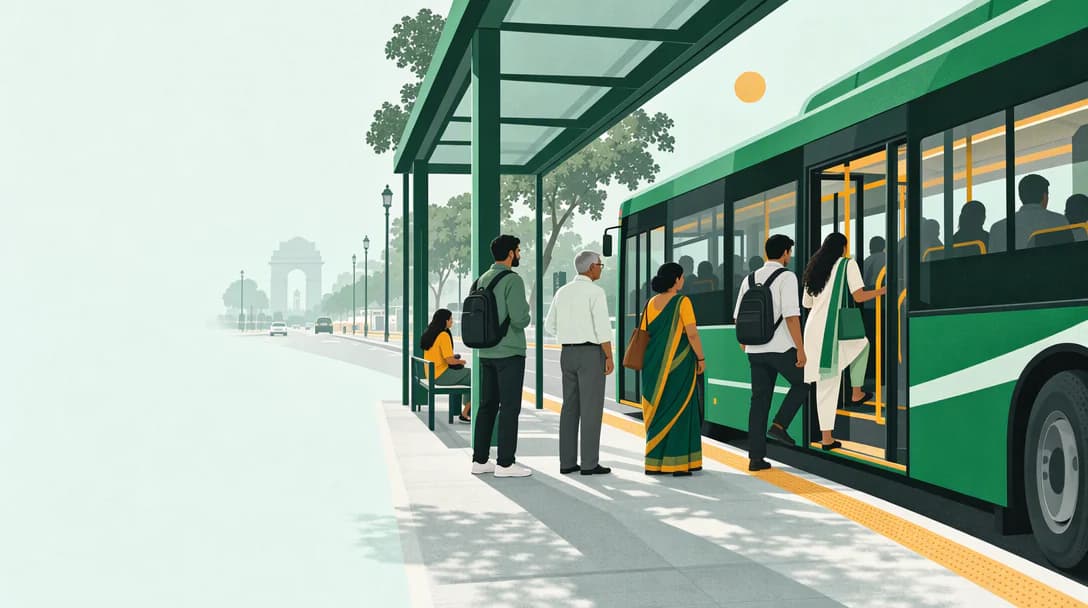
Riding a Delhi bus takes five steps: find the route, find the right stop and side of the road, check the destination board, pay the conductor or tap your card, and watch for your stop. Delhi’s 754 route numbers call at 5,217 stops, so there is usually a bus close by.
1. Find which bus goes where you are going
If you know two well-known places, start with bus trips between Delhi’s main places: stations, ISBTs, the airport, markets, hospitals and big neighbourhoods, each with the direct routes between them. For any two exact stops, use Plan a trip. If someone gave you a route number, open it from all routes to see every stop it calls at.
2. Stand at the right stop, on the right side
Most Delhi stops exist twice, one on each side of the road, and buses only stop on the side where they are heading your way. On BusPe, every stop page lists the buses that call there and where each one is heading. If your destination is not among them, cross to the stop with the same name on the other side. The stop and direction guide explains this in detail.
3. Board and pay
- Board at the front or the rear door, whichever the bus uses for entry, and move inside.
- Tell the conductor where you are going. Fares are charged by distance: ₹5, ₹10 or ₹15 on non-AC buses and ₹10 to ₹25 on AC buses. See Delhi bus fares for each route’s fares.
- Carry small change. Many buses also accept digital payment and the National Common Mobility Card (NCMC); ask the conductor.
- Women, girls and transgender persons who live in Delhi travel free with the Pink Saheli Smart Card. Paper pink tickets stopped on 31 July 2026. Read the fares and passes guide.
- Keep your ticket until you get off. Ticket checkers can ask for it during the trip.
4. Know when to get off
Open the route page before you board and keep its stop list handy: it shows every stop in order, so you can count down to yours. On longer trips, the live map helps you see where buses on your route are. Move towards the door a stop early, because buses do not wait long at busy stops.
5. Changing buses
When no single bus runs between two places, BusPe shows trips with one change at a stop both routes share. Big interchanges such as ISBT Nityanand Marg and GPO have the most onward routes. You buy a new ticket on the second bus.
Which bus is which
Delhi runs two fleets: DTC buses and cluster buses run by private operators under the Delhi Government’s cluster scheme. Tickets, passes and the Pink Saheli card work on both. Route numbers tell you roughly where a bus runs; see how route numbers work and DTC vs cluster buses.
Safety basics
- Seats marked for women, senior citizens and people with disabilities are reserved for them.
- Keep phones and wallets in a front pocket or bag in crowded buses.
- In an emergency, call 112. More numbers are in the helplines guide.
Quick answers
How do I pay for a Delhi bus ticket?
Pay the conductor on board with cash, or ask about digital payment and NCMC cards. Fares are charged by distance, from ₹5 on non-AC buses to ₹25 on the longest AC trips.
Can I use the same ticket on two buses?
No. A single-journey ticket is for one bus. If you change buses, you buy another ticket, unless you hold a pass.
How do I know which side of the road to wait on?
Look up the stop on BusPe. Each stop page lists the buses that call there and where they are heading. If your destination is not among them, use the stop with the same name across the road.
Is it free for women to travel on Delhi buses?
Yes for women, girls and transgender persons who live in Delhi, using the Pink Saheli Smart Card on DTC and cluster buses.
Fares and schemes are set by DTC and the Government of NCT of Delhi and can change. BusPe is independent and not affiliated with DTC, DIMTS or the Delhi Government. Spotted something wrong? Tell us.